What Term Is Used to Refer to Any Short Musical Gesture Repeated Over and Over Again


Repetition is important in music, where sounds or sequences are often repeated. It may be chosen restatement, such equally the restatement of a theme. While it plays a role in all music, with noise and musical tones lying forth a spectrum from irregular to periodic sounds,(Moravcsik, 114)(Rajagopal,[ page needed ]) it is particularly prominent in specific styles.
Repetition [edit]
A literal repetition of a musical passage is oft indicated by the use of a repeat sign, or the instructions da capo or dal segno.
Repetition is a part and bundle of symmetry—and of establishing motifs and hooks. Yous find a melodic or rhythmic effigy that you lot like, and you repeat information technology throughout the course of the melody or vocal. This sort of repetition...helps to unify your melody; it's the melodic equivalent of a steady drumbeat, and serves as an identifying factor for listeners. However, too much of a good thing tin can go abrasive. If you repeat your figure too ofttimes, it will showtime to diameter the listener.
—(Miller, 106)
Memory affects the music-listening feel and then greatly that information technology would non be hyperbole to say that without memory at that place would exist no music. As scores of theorists and philosophers have noted...music is based on repetition. Music works because nosotros remember the tones we accept just heard and are relating them to the ones that are just now being played. Those groups of tones—phrases—might come up upwards later in the piece in a variation or transposition that tickles our memory organisation at the same time every bit it activates our emotional centers...(Levitin, 162–163)

Echo sign with first and second endings
Theodor W. Adorno criticized repetition and popular music every bit beingness psychotic and infantile. In dissimilarity, Richard Middleton (1990) argues that "while repetition is a feature of all music, of whatsoever sort, a high level of repetition may exist a specific marker of 'the popular'" and that this allows an, "enabling" of "an inclusive rather than sectional audience"(Middleton 1990, p. 139). "At that place is no universal norm or convention" for the amount or type of repetition, "all music contains repetition – only in differing amounts and of an enormous variety of types." This is influenced by "the political economy of product; the 'psychic economy' of individuals; the musico-technological media of production and reproduction (oral, written, electric); and the weight of the syntactic conventions of music-historical traditions" (Middleton 1990, p. 268).

Thus Middleton (likewise 1999) distinguishes between discursive and musematic repetition. A museme is a minimal unit of meaning, analogous to morpheme in linguistics, and musematic repetition is "at the level of the brusk effigy, often used to generate an entire structural framework." Discursive repetition is "at the level of the phrase or department, which more often than not functions equally part of a larger-scale 'argument'." He gives "paradigmatic case[s]": the riff and the phrase. Musematic repetition includes circularity, synchronic relations, and openness. Discursive repetition includes linearity, rational command, and self-sufficiency. Discursive repetition is most often nested (hierarchically) in larger repetitions and may be idea of every bit exclusive, while musematic repetition may be idea of as condiment. (p. 146–148) Put more simply, musematic repetition is simple repetition of precisely the same musical figure, such equally a repeated chorus. Discursive repetition is, "both repetitive and non-repetitive," (Lott, p. 174), such equally the repetition of the same rhythmic figure with different notes.
During the Classical era, musical concerts were highly expected events, and considering someone who liked a piece of music could not heed to it again, musicians had to think of a way to make the music sink in. Therefore, they would echo parts of their song at times, making music like sonata very repetitive, without existence dull.(Bowen)
Repetition is important in musical grade. The repetition of any section of ternary form results in expanded ternary form and in binary form the repetition of the beginning section at the end of the second results in rounded binary form.(Benward & Saker, 315) Schenker argued that musical technique's, "nigh striking and distinctive feature" is repetition (Kivy, 327) while Boulez argues that a loftier level of interest in repetition and variation (analogy and difference, recognition and the unknown) is characteristic of all musicians, especially contemporary, and the dialectic [conversation] between the two creates musical form.(Campbell, 154)

"Au clair de la lune", repetition subsequently digression.(Copland & Slatkin)  Play(help·info)
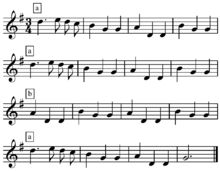
"Ach! du lieber Augustin", repetition after digression.(Copland & Slatkin) Play(help·info)

"The Seeds of Dearest" (English language folk song), nonrepetition.(Copland & Slatkin) Play(help·info)
Types of repetition include "verbal repetition" (aaa), "repetition after digression" (aba or aba'), and "nonrepetition" (abcd). Copland and Slatkin offering "Au clair de la lune" and "Ach! du lieber Augustin" Play(help·info) as examples of aba, and "The Seeds of Beloved" as an example of the terminal.(Copland & Slatkin, [unpaginated ])
At the tone level, repetition creates a drone.
Repetitive music [edit]
Some music features a relatively high caste of repetition in its creation or reception. Examples include minimalist music, krautrock, disco (and its afterward derivatives such as house music), some techno, some of Igor Stravinsky'southward compositions, barococo and the Suzuki method. (Fink 2005, p. 5)
Other important genres with repetitive songwriting are post rock, ambient/dark ambient[one] and black metal.[2]
Psychological interpretations [edit]
Repetitive music has often been negatively linked with Freudian thanatos. Theodor W. Adorno[three] provides an case in his criticism of Igor Stravinsky, whose, "rhythmic procedures ostinato closely resemble the schema of catatonic weather. In sure schizophrenics, the process by which the motor apparatus becomes contained leads to infinite repetition of gestures or words, following the decay of the ego." Similar criticism was levelled at Ravel'due south Bolero.
Wim Mertens (1980, pp. 123–124) argues that "In repetitive music, repetition in the service of the expiry instinct prevails. Repetition is not repetition of identical elements, so it is non reproduction, but the repetition of the identical in some other guise. In traditional music, repetition is a device for creating recognizability, reproduction for the sake of the music notes of that specific line and the representing ego. In repetitive music, repetition does not refer to eros and the ego, but to the libido and to the death instinct."
Repetitive music has as well been linked with Lacanian jouissance. David Schawrz (1992, p. 134) argues that the repetition in John Adams's Nixon in Mainland china is "trapping listeners in a narrow audio-visual corridor of the Real" while Naomi Cumming (1997, p. 129–152) argues that the repetitive string ostinatos of Steve Reich's Different Trains are "prearticulate" pieces of the Existent providing a refuge from the Holocaust and its "horror of identification."
Genres that use repetitive music [edit]
DJs at disco clubs in the 1970s played a smooth mix of long single disco records to keep people dancing all nighttime long. The twelve-inch unmarried was popularized as a means to this end. While disco songs practise have some repetitive elements, such as a persistent throbbing vanquish, these repetitive elements were counterbalanced by the musical variety provided by orchestral arrangements and disco mixes that added different audio textures to the music, ranging from a full, orchestral sound to stripped-down break sections.
The electronic dance music genres that followed disco in the 1980s and 1990s, such as house music and techno kept the bass drum rhythm introduced past disco simply did non utilise the orchestral arrangements or horn sections. House and techno had a more minimalist sound that layered electronic sounds and samples over a drum car drum part and a repetitive synth bass bassline.
Extremely repetitive song structures are as well used by some black metallic bands like Burzum,[iv] Darkthrone, Forgotten Forest, Lustre and Striborg.
Come across also [edit]
- Cycle (music)
- Groove (music)
- Imitation (music)
- Melodic pattern
- Ostinato
- Paradigmatic analysis
- Drone music
- Repeat sign
- Reprise
- Sequence (music)
- Abbreviation (music)
References [edit]
- ^ Aphex Twin:Selected Ambient Works Book II
- ^ Ben Ratliff (Nov sixteen, 2009). "Repetitive Guitar Strums Rooted in Metal but Not Confined by Information technology". The New York Times.
- ^ Adorno 1973, p. 178.
- ^ Burzum, markprindle.com
Bibliography [edit]
- Adorno, Theodor Due west. (1973) [1948]. The Philosophy of Mod Music. Translated by Anne K. Mitchell; Wesley V. Blomster. Cited in Fink 2005.
- Benward & Saker (2003). Music: In Theory and Practice, Vol. I. Seventh edition. ISBN 978-0-07-294262-0.
- Bowen, Nathan. "Double Expositions and the utilize of repetition in Classical Music". Nathan Bowen's Blog. Blog Annal. Retrieved 6 March 2011.
- Campbell, Edward (2010). Boulez, Music and Philosophy. ISBN 978-0-521-86242-4. Cites Boulez 2005b, 156 and 239.
- Copland, Aaron & Slatkin, Leonard (2011). What to Listen for in Music. ISBN 978-i-101-51314-9.
- Cumming, Naomi (1997). "The Horrors of Identification: Reich'southward Different Trains" Perspectives of New Music 35, no. I (Wintertime).
- Fink, Robert (2005). Repeating Ourselves: American Minimal Music every bit Cultural Practice. ISBN 0-520-24550-4.
- Kivy, Peter (1993). The Fine Fine art of Repetition: Essays in the Philosophy of Music. ISBN 978-0-521-43598-7.
- Levitin, Daniel J. (2007). This Is Your Encephalon on Music: The Science of a Human Obsession. ISBN 978-0-452-28852-2.
- Lott, Eric (1993). Love and Theft: Greasepaint Minstrelsy and the American Working Class. Oxford University Press. ISBN 0-xix-509641-X. Cited in Middleton.
- Margulis, Elizabeth Hellmuth (2013). On Repeat: How Music Plays the Mind. Oxford University Press. ISBN 978-0199990825.
- Mertens, Wim (1980/1983/1988). American Minimal Music, trans. J. Hautekiet. ISBN 0-912483-15-six. Cited in Fink 2005.
- Middleton, Richard (1990/2002). Studying Pop Music. Philadelphia: Open University Press. ISBN 0-335-15275-ix.
- Middleton, Richard (1999). "Course". Cardinal Terms in Popular Music and Culture, Horner, Bruce and Swiss, Thomas, eds. Malden, Massachusetts. ISBN 0-631-21263-9.
- Miller, Michael (2005). The Complete Idiot'southward Guide to Music Theory. ISBN 978-1-59257-437-vii.
- Moravcsik, Michael J. (2001). Musical Sound: An Introduction to the Physics of Music. ISBN 978-0-306-46710-iii.
- Jonas, Oswald (1982). Introduction to the Theory of Heinrich Schenker (1934: Das Wesen des musikalischen Kunstwerks: Eine Einführung in Die Lehre Heinrich Schenkers). Translator:. John Rothgeb. ISBN 0-582-28227-vi.
- Rajagopal, K. (2007). Engineering science Physics. ISBN 978-81-203-3286-7.
- Schwarz, David (1992). "Postmodernism, the Subject, and the Existent in John Adams'south Nixon in China" Indiana Theory Review 13, no. ii (fall). Cited in Fink 2005.
Further reading [edit]
- Attali, Jacques (1977/1985). "Repeating" Racket. ISBN 0-8166-1287-0.
- Julien, Olivier & Levaux, Christophe (ed.) (2018). Over and Over. Exploring Repetition in Popular Music. Bloomsbury Bookish. ISBN 9781501324888.
- Margulis, Elizabeth Hellmuth (2014). On repeat: How music plays the mind. Oxford University Press. ISBN 978-0199990825.
Source: https://en.wikipedia.org/wiki/Repetition_%28music%29

Post a Comment for "What Term Is Used to Refer to Any Short Musical Gesture Repeated Over and Over Again"